Thursday, September 26, 2013

Lalah Hathaway

I like Lalah Hathaway. I love Lalah Hathaway. I like following what she's doing even when I'm not in love with all her music, because she is clearly in it for the long haul, constantly exploring her musical choices and becoming more masterful. I love her voice, and I love hearing what she does with it - those two things together are very exciting. She has a huge range, but she uses it as she wants to, musically, not to point out how big it is. Her bottom range is really unusual - unusually big, controlled, deep, fluid, solid. I don't offhand know any other women vocalists who live so much in lower registers like that except maybe other jazz musicians (which I'm not that familiar with.) Not even opera mezzos or contraltos. Nor, for the record, am I sure if she more properly belongs in R&B or jazz. Not sure that matters.

She opens up songs in amazing ways. I'd argue one of her biggest strengths is as a cover artist, as she takes songs and plays with them and makes them totally hers, something she does without having to fill in every last empty space. She's a musician. I have been more than a little obsessed for the last 10 years with how she has turned Luther Vandross' "Forever, For Always, For Love" into her song; I'm always listening to the latest version. In concert it's now 10-12 minutes long (usually with a very long guitar solo in the middle), and she is willing to be slow, to be quiet, to be precise, to live in it. It's full of flourish and ownership, but it can also sound simple - sometimes - made of the kind of simplicity that "could only have sprung from the highest art," as E.F. Benson would say. It's exhilarating. A clinic.

Anyhow, she has been doing this thing more and more recently that is really fun to listen to: she harmonizes with herself. She sings two - or three - notes at a time. Like throat singing. (Or David Lee Roth!) Maybe it more properly belongs in the category of a stunt or trick, but there is something so cool about it, not to mention watching audience members and fellow musicians alike lose their minds when they hear it. She doesn't do it like a big ta-dah or kicker at the end of a performance or something - she does it with a lot of musical care, like all her singing - but either way there is something incredible about hearing these noises - hearing a chord - come of out of a human being. People go INSANE.

Some spots to hear it:

- in the middle of call and response, singing Randy Crawford's "Street Life" - c: 6:45 (if you don't listen to the whole thing, at least start at 6:00 to hear her play with Arabic-style vibrato)

- singing "Something" with Snarky Puppy - c. 6:10 - 6:25 (watch the musicians go bonkers)

- singing "Summertime" with: Jason Morales - c: 5:30 - 7:00

- a clip of her doing it (not sure what song it is) - c: 0:15

- another clip - her bit is 0:00 - 2:15 and the self-harmonizing happens around 1:30 - 2:00, after she throws in bits of The Wiz

If you're not familiar with Hathaway, here is a bit of her singing Anita Baker's "Angel," showing off some of how she does, in general:


Here is my current fav version of her singing "Forever, For Always, For Love" (Paris, 2012). (Also great: versions with Errol Cooney on guitar -  this is another really gorgeous version.) All the clips from this concert in Paris are fun, because you can really see her leading her band, being in charge. Make sure you hear 4:30 - 5:30:


And here, of course, is her father, who is, you know - god. She does sound like him, I think. The size of her voice is sort of shaped the same way, with that insane bottom to it.

Tuesday, September 03, 2013

Monday, August 12, 2013

How silly Rhoda is, thought Deirdre, almost as if she were interested in Father Tulliver in a flirtatious way. She was as yet too young to have learned that women of her aunt's age could still be interested in men; she would have many years to go before the rather dreadful suspicion came to her that one probably never does cease to be interested.
Less Than Angels, Barbara Pym

Thursday, June 06, 2013

great iPhones news photos in history

Phil Rosenthal started this hashtag - #iphonenewspics - yesterday. Silly. Extremely satisfying. These are some of the ones I've made so far. Hard to stop.

Iwo Jima!

situation room...Bin Laden

a Great Day in Harlem
cops pepper spray at #OWS
1968 Olympics...I think they're checking
their shoelaces or something?
Einstein selfie
tear gas in Turkey
migrant mother, Dorothea Lange
...sorry about the thumb
Wright Brothers
Mission Accomplished!

Monday, June 03, 2013

on some aesthetics of Behind the Candelabra

Some of what has made Behind the Candelabra, the Steven Soderbergh adaptation of Scott Thorson's book about his life with Liberace, stick with me is the poignant universality of the story: Matt Damon's vulnerable, sometimes heartbroken face as Thorson as he goes from naif to betrayed, jittery ex. Damon is wonderful. Some of it is a longtime fascination with stories of the old and closeted – or just those aging and trying to live their lives with glamour – in Hollywood. Many times this movie reminded me of scenes in Armistead Maupin's Further Tales of the City (1982), in which the protagonist Michael visits the Beverly Hills house of a character based very obviously on Rock Hudson (named "_____"). In one scene Michael is talking to the knowing houseman, Guido, as "twinkies" show up for a welcome-home pool party for _____:
One by one, the young men began arriving, long-limbed and Lacosted to near perfection.
"What is this?" asked Michael, hovering near the kitchen. "The summer spread of GQ?"
"They wish," said Guideo, frantically fluffing the parsley on a tray of deviled eggs. "They're anybody's spread at this point . . . and honey, when you've been in this business as long as I have, you see them come and you see them go. Mostly come . . . ya know?"
"They're so gorgeous," said Michael. "Are they actors or what?"
"What, mostly. Starlets. Harry Cohn knew all about it, only he did it with girls. Same difference. Same dumb dames standing around the pool."
But a big part of how Behind the Candelabra has stuck with me, it turns out, is how it was made. To this story, which in some ways is not a new one, the film brings precise and artistic movie craft, including a few qualities that really stuck out.


One great effect was the marriage of all the Liberacean "palatial kitsch" to pervasive yellows and glowing, often blown-out light that saturates the film – something I think of as a Soderbergh hallmark. There is yellow and gold all through this film – hair, walls, cars, houses, jewelry – but most of all: light. Light radiates back from Behind the Candelabra, from the shining yellow incandescence inside Liberace's homes and dressing rooms, to the the whited-out glare of the Palm Springs sun, to the colder but still bright-burning stage light. The light hits ominous objects like the never-ending pile of prescriptions Dr. Startz (Rob Lowe) hands Thorson, turning them into pretty luminous squares. From the very first shot – at a gay bar with Damon's back to camera – to Liberace's deathbed scene near the end, as the gaunt Michael Douglas lies on gold satin sheets that shine at the camera, the film glows with Soderbergh yellow.


All this light – which doesn't blur or obscure detail – it tends to make things sharper, even as it creates excess – does one important thing for the movie and its depiction of life inside the jewel box: brings it closer. It animates the insane interiors and spaces Liberace lived in. When you look at old photos – long shots – of Liberace's mirrored rooms and crazy gilded furniture, they can have a kind of bluish, dated feel. I mean, they would, by just virtue of age, but images of the kitschy and ornate decor of his homes – of his self – can feel kind of overwhelming and cold. The light creates focus, lets you marvel at the baroque spaces without getting lost in them. The scenes when the film's palette departs from the warm glow – at the glory holes, lit in purple neon, or the greenish light of the operating rooms during the plastic surgery scenes, or the flat white light in Damon's drug buddy Mr. Y's (Nicky Katt) house after the breakup – tend to feel disorienting, hint at discord. The yellow tends to animate the closest parts of Damon's and Douglas' life together; the other tones often fall outside of it.

The sound in Behind the Candelabra is wonderful, with subtle but sure, judiciously-chosen changes in ambient noise that put happenings in precise place, such as the distant barks of Liberace's dogs in other rooms, or a shot of an an announcement from the Palm Springs coroner (note: more blistered sunshine), which arrives with the sudden buzz of the cicadas that immediately reminds you these opulent Palm Springs interiors actually hide inside desert bunkers:

And the score was great. I have thought a lot about what it means that all the years of Liberace's life he spent playing the piano – decades – and creating his defanged, glammed-up versions of classical music, might make the most sense these days as snipped-off bits in a movie score. (I don't know what it means – I've just been thinking about it.) Soderbergh had amazing riches to choose from – music to undercut, to underline, some of it actually really beautiful. Off-hand the only time I remember hearing any other kind of music in this film is the opening scene, which is scored with Donna Summer's "I Feel Love." The song choice – and the way the song goes from straight soundtrack to sounding like it's being played in a club – makes it clear right from the beginning where this young man is coming from, in every sense.

There are no opening credits in this movie. The scene at the gay bar opens it, after just a card with the year on it:
...which for me (I don't know about you) immediately puts me in mind of 70s to mid-80s album covers. (The type is Sante Fe, designed by David Quay in 1983.) It harkens to diner script and neon signs, and to earlier 20th century script typefaces, but in my mind it feels firmly connected to 70s/early 80s deco. That open join in the "9" immediately dates it, as do the rounded ends of the monolineal characters.

Which brings us to a small detail – in terms of screen time – that really cinched my affection for this film. There are no title credits in Behind the Candelabra, but the end credits, which represent the film's first major graphic design decision, open with this extremely tasty image. I think I sighed when I saw it:


Edwardian Script, a typeface designed by the legendary Ed Benguiat in 1994, is tricky as hell, I think. I'm almost never happy to see it. Even in 2013, with ever-changing design rules, it is tricky. It looks, at a squint, like a lyrical and strenuously uniform/classically regular copperplate typeface, but the minute you're closer you can see it is also emotional and all over the place, especially for one designed to suggest elegance and formality.

You can see some of it the craziness with an up-close look at the join from O to D and the lower-case R, here:

These are bold and variant shapes within the thicket of more regular ups and downs (they almost look like Benguiat shaded in the loops by mistake, as if the ink in his pen had gushed a little there). The thicks and thins often take their own pace; they are not as uniform as they seem at first look (Benguiat created some amazing brush and script typefaces, which fits with this). And Edwardian has some kooky bulb terminals, as in the S and the X, below – look at those things!

I think it's very hard to use the right amount of Edwardian Script. It's not just formal – but it's not just nutty. All those joins and curves, which almost look like blown-up or close-up versions of joins in other typeface, can both lose their effect or have too much effect – overwhelm – unless administered at correct dosages: amounts that let you see the wacky curves and terminals but not get lost in them. And I'm not even taking on the genuinely florid Edwardian capitals, which are excessive and increase illegibility quite a bit when used more than one a word.

In the time that Behind the Candelabra takes place - at the time Liberace Cooks! (for instance) was published in 1970 – there was, in my memory, a lot of lettering like that. A lot of thick, packed-together, flourish-heavy type of a kind you see echoed a bit in Edwardian Script.
You can see when you look a bit closer that the K has an even bigger bulb terminal than the one in the Edwardian Script "X":


A much more common type of copperplate typeface for the moment – Bickham, for instance – renders letters quite differently:

The thicks are less thick and extend for much longer (and along the longer ascenders and descenders), with less variation, shortening and standardizing the transitions from thick to thin that can be so dramatic in Edwardian Script. It leans at a much steeper angle, feels more full of directed movement, rather than movement held inside the letters in Edwardian Script, which can feel kind of static, as if the letters are cages. The curves in Bickham are shallower, the effect much more regular. To me it's a much more pleasing script to the eye, closer to a hand-written script. Edward Script feels drawn.

The way Behind the Candelabra uses Edwardian Script was genius, though. Weirdly, intensely so. It is perfect for a film steeped in kitsch yet apart from it, and absolutely perfect for Liberace in his particular kind of aesthetic of excess. The amount of Edwardian Script they used was great: small and careful, yet clear (another prob with Edwardian I think – lack of clarity), pushed to the front by the soft focus behind it. The limited use of capitals is good – oh the title card! [top image] It makes me drool a little, with that bitchen backward flourish at the top of the C contrasting with the line of type marching next to it... The flat pastel candy color choices contrasted beautifully with the metallics and shiny golds of the tiny pianos, the scale of which set off the whole effect perfectly. The color was genius, period; it embraced, rather than fought with, this type's inability to quite fit in the box. There was – this was the real key, maybe – enough air around the text to give the Edwardian room to be read, and for all the kineticism within the letters to dissipate, and for the regularity in the letters, which is there, to shine through too, and wrap up the movie – tell us it was over.

(detail)


It is all very...Liberace. Elegant but cheesy – all those swirls and shapes are cheesy. Constrained but florid and romantic. Kind of crazy. A little geriatric, a little dated, a little fabulous. A little bit Precious Moments, a little bit louche. Little jewels of text, next to the tiny, jewel-like pianos.

Does this sound crazy? I care desperately about letters, but I am in many ways more of a self-taught calligrapher than a designer and don't always know if history and the graphic arts back up my visceral reactions. Or if I'm missing things. All's I know is that this was about the first time I ever had a happy reaction to Edwardian Script. The end titles are just gorgeous, and gorgeous in context.

The movie is worth seeing, if you haven't, and I am guessing, given how strong I found the visuals, would have been much better shown first in a theater. I would have loved to drink them in on the big screen.

p.s. A truly great insult from this movie: "You cock-sucking tenor fuck!"

p.p.s. The poster is great too, with its bejeweled lettering: Poppl-Exquisit, I think, a much better choice for the poster than Edwardian Script, but I wish they'd un-capitalize the T in "The"!

Wednesday, May 01, 2013

boys club

I made the graphic below for this Boys Clubs Tumblr about institutions that are all men because I have been thinking about it/noticing it for months: every single host of a show on the Travel Channel is a white man. Note: Samantha Brown is still listed as a host on the Travel Channel website, but I haven't actually seen her show on Travel Channel or on TV schedules for months. All these other shows are actually broadcast regularly right now.


These casting choices feel full of meaning, taken together. Among a million things, that: white men are the expert conduit through which the unusual/fun/exotic/interesting/unfamiliar/delicious are experienced and their identity therefore defines all of those things (by comparison); that their eyes are the ones that can be trusted for observation; that men are the only ones badass enough to travel around and do what they do. I really don't like how Travel Channel sells itself, which leans heavily on that last idea. And I really love travel shows! I enjoy some of these shows occasionally. But boy, is it a narrow window through which to look at the whole wide world.

Their newest show, premiering later this month? Hosted by Bret Michaels.

deep thoughts from S06E05

Friday, April 05, 2013

Roger Ebert Is Gone

When I read on Twitter that he had died I was actually sitting at my desk trying to decide what to send him to acknowledge his newest trouble with cancer. Nothing that made for sickbed hassle... A card? A note? A note. On a piece of engraved stationery from my hoarded, dwindling stash. He'd appreciate that. A nice note with words that I'd hope would convey the right type of clear-eyed compassion - the kind of words he always chose: wise, kind, smart, with the beautiful responsibility and directness of a lifelong newspaper man. I would have been careful to not write "Get Well," but, still, something as cheerful and real as I could make it. Writing to him always made me think very hard about the words I chose.

It doesn't matter now, because it's over. It was always going to feel too soon. He had been articulating his death in his strong voice for a long time, but it still hurt when it came, felt an unfairness.

I knew Roger Ebert a little bit. I have my small bag of stories, and I keep it more carefully than I do many things in my life. I don't think my stories are unusual - many, many people have them - and I know the same thing from mine that I know from reading other people's: he was generous. It's such a boring word for what it describes. Maybe because "generous" is sort of outwardly-focused  - opens things up. It's a little vague. There was nothing diffuse in dealing with him, though. He was extremely focused, strongly himself, loyal to his thinking and his emotions. But he showed the best kind of confidence by being interested in and open to others.

I first knew him in 1999 because I sent him my zine. It was an impulsive move, born of killing myself for weeks to finish the second issue only to immediately have no clue what to do with it (a common feeling upon finishing a zine). Then I thought: Roger Ebert! He lives in Chicago too. He loves opera and movies and is an Anglophile, like me. He likes Doris Day and MFK Fisher, like me. I will send my work to him - he might like it. I followed my finger down a page of Who's Who until I found his business mailing address, and flung the zines in the mail with a note. Hail Mary.

I was at work three weeks later on a Monday, after a bad weekend spent dealing with the noise and stereo twiddlings of a crackhead neighbor. As I started miserably slashing through my inbox I was stopped by the sight of an email from Roger Ebert - Roger Ebert, just like any other person. His name shone calmly in the queue onscreen amidst waves of the usual frantic work horseshit.

When I think back I can immediately access the physical sensations that swamped me as I figured out what I was seeing. Adrenaline was shooting through every limb. I kept getting up and sitting back down, leaving my office and coming back, doing laps through the office cubicles with a huge involuntary smile on my face, letting out little yelps.

He wrote me that he did not have time to read 95% of the stuff that was mailed to him ("no human being would") but that his eye had fallen on my zines and started reading. "You are some writer," he told me. It turned out one of my favorite childhood books, Cheaper by the Dozen, had been a favorite of his too, and he offered to submit an essay I had written about it to a literary review on my behalf; "help it through the slush pile."

He offered clear, concrete help right off the bat. I still marvel at the effect of that, years later. He read my work, told me it was "of a high professional standard," and he offered to help me, right then. As it turns out the review did not accept the piece, but Roger's email came at the beginning of a period in my life in which I changed jobs and started to publish work, including, eventually, a (better, reworked) version of the Cheaper by the Dozen piece. As obvious as it seems now, it really is only in retrospect that I can see that every communication with him provided real fuel to my life.

In the ten years following, we sent the occasional email. In winter 2004, I messed up a good chance to talk to him in person. I had seen him a few times on the street in passing in earlier years, but this time I was at the theater on Lake Street where Chicago critics see their films, and when I stumbled into the elevator, sweaty and late for a screening, there he was. Standing with someone else, I forget whom (not Chaz, I think), and wrapped up in his winter coat. I just couldn't bring myself work through our outerwear to do the introducing.

That was because I was at the beginning of a period of bad health and quite bad physical mobility that I would acknowledge to no one, and I just could not - did not have the energy to - navigate explaining who I was, sweating with pain as I tried to stay upright, and finding the Right Seat among critics who all had their own spots already, all in the 90 seconds before the film was to start.

So I cravenly avoided his eyes. It pains me to remember that moment now. Now I think that no matter what I should have talked to him, or found him after the show, which I hoped would happen, but didn't. But then I was quite embarrassed by my inability to stand or walk well and didn't have the courage to push it. It's sad in so many ways to think about this: a dumb missed chance (forever), dumb vanity, the poignant fact that he, more than many, might have been able to understand my physical limitations. I did email him later and tell him I had seen him in the elevator. I lied, basically; I said I had been too unawake and uncaffeinated to realize who he was in time to say hi...blah blah. It was stupid. He wrote back a variation on No-way-that-was-you-say-hi-next-time-you-idiot.

In 2009 I got in touch with him again, pushed to do so by two things (three, if you include a smart friend). For one, I was exhilarated by the writing he was doing then, by how good his long-form autobiographical pieces were (such as those on drinking - at O'Rourke's - and on not drinking - at AA). I wanted to tell him how exciting I found his work, how it married intelligence and the humbling specifics of human experience in ways that I couldn't stop thinking about. I also wanted to tell him how much I admired how he handled his illness (and deadlines!), especially as a public figure. By then I knew how hard addressing long-term illness is. For myself, at least. How much it shapes your life, how hard it is to get better, how getting better can be as tricky as getting worse, how you have both no control and too much control over the little things that happen and what an exhausting drain every situation is. I knew that he had spent time at the Rehabilitation Institute of Chicago, which is where I had done rehab too. At that point I could have stood in the elevator and introduced myself to him - although at that point he couldn't have spoken back.

I got his new email address from a friend and sent him a letter. He wrote back quickly (he always did), said that he was enjoying writing more, "and, I daresay, better than ever," and told me that he liked my blog and had tweeted about an entry (props to Rog for using the word "fat" in a neutral, descriptive fashion, by the way). He did this again in subsequent years about a few things I sent him: once tweeting a piece I had written about Jeff Bridges (by then I understood Twitter better and what it meant to have Roger Ebert tweet about something you had written, holy cow) and last year Facebooking something I had written about Brideshead Revisited. Each time it happened there would be a brief silence after his email arrived before my Twitter and email notifications would start bonging loudly, my face would get red, I'd yell and jump around, my blog hits would (temporarily) spike to 8,000 a day, and I'd chant to friends over and over, "such a mensch...he's such a mensch!" I never got cool about this. I'd try to write thank-you letters that I hoped weren't too fulsome, or demanding in any way. Or as hyper as the jumping around.

I hope that it isn't too conceited that in describing his generosity I also relate experiences of good fortune in my life (doesn't seem to be any way around that). I want to show how smart and generous he was with me with the power he had. Ours was not a balanced relationship - he could give me more than I could give him - but he did it gorgeously. I always aware of who he was, but mostly I just wanted to show him what I had been thinking about. Share it.

Around ten months ago I decided I wanted to send him a present. From reading his work and keeping a brutal eye on what I could see of the facts of his health I was worried I'd be too late if I didn't do it sooner rather than later. I didn't want to miss him again like on Lake Street, miss him for good. I wanted to tell him directly how much his encouragement had meant to me over the years. I could clearly see the day coming - today, it turns out - when I would be one of thousands of people at their keyboards trying to describe what he meant to us. I didn't want him not to know.

I sent him a two-volume edition from the 1930s of the complete works of Saki in beautiful dust jackets, enjoying the process of packing it up just so, writing the right note, padding to the post office. I knew he'd like them. He sent back a spectacularly sweet thank-you letter that I feel too weepy to reproduce here. And then not long after wrote me back again to say: I want to give you some books too. What do you like?

That threw me. If he had been a better friend I would have risked a couple emails to wave him off, saying no, no, they are for you, you owe me nothing, ya dope. But because he was Roger Ebert I couldn't. I felt a little slapped in the face, to get his return offer so fast after my long-planned present. Or as if I had perhaps initiated an uncomfortable and never-ending ping-pong match of escalating gift-giving. Or, worriedly, as if I had maybe created an uncomfortable obligation on his end. But with a little time to think it over (thank God for time, sometimes) I realized: this is a man who will probably not live that much longer. It would be unkind to refuse him the pleasure of giving something. Let him do that. Let him put some books where he wants them.

So I learned yet another thing from him in the end of his life. I listed some favorite authors (he told me he liked my taste and I died another happy little death) and he sent me a few books that I now cherish. I don't really want to say what they are for some reason; he didn't send me Shakespeare Folios - just books that were perfect for me and provided a few new literary directions to sniff in. I have been reminded in the last few days how early I started learning new things from him; how much watching Siskel & Ebert with my family as a teenager influenced me. Decades of my life he informed. To be a critic, he wrote, was to be a teacher.

When he wrote me in 1999 to tell me the Cheaper by the Dozen piece had been turned down, he sent some advice in an email that I printed out and have had hanging on my wall for the almost fifteen years since then. I don't know if I've been able to follow it the way he did himself (very few people could), but it makes me feel special to have been the recipient of it and to have ever had his hilarious, wise eye on me at all:
Well, I guess acceptance the first time out would have been too much to expect. But you DO have a voice--yours--and if you plug away you will be a famous and beloved writer before you know it. (Human nature being what it is, you will have retained the words "famous and beloved" from the previous sentence, when of course "plug away" is the key content.)
very best,
RE 
I love that he had my and every other writer's number in that last sentence. And that he signed his emails "RE" then, which (I told him) always reminded me of studio mogul "RF" Simpson in Singin' in the Rain.

I loved learning from him in recent years, loved his vulnerable but fiercely steady take on life and loss. I loved that he wasn't scared to care. I loved that his life prompted me to want to find always better-chosen words, showed me that it was worth telling him what he meant to me before it was too late, although I don't think I ever guessed how soon he'd go. I hope I can even try to be as dogged, as giving, as curious, as of my time and of my life as he was of his - to contribute, as he said, "joy to the world . . . no matter what our problems, our health, our circumstances. We must try."

- § -


Monday, March 25, 2013

Michael Ramsay, Archbishop of Canterbury during my childhood and during my religious phase a hero and profound influence, was once accused by an interviewer of being wise.
"Am I?" he asked. "I don't think so really. I think it is probably just the impression given by the absurd fecundity of my eyebrows."
"Well, your Grace," the interviewer persisted, "how would you define wisdom?"
"Wisdom?" Ramsay chewed the word around in his mouth. "Oh, I should say that wisdom is the ability to cope."
Moab Is My Washpot, Stephen Fry

Friday, March 15, 2013

"I play the piano a good deal," he said "I have a seven-foot Steinway. Mozart and Bach mostly. I'm a bit old-fashioned. Most people find it dull stuff. I don't."
"Perfect casting," I said, and put a card somewhere.
"You'd be surprised how difficult some of that Mozart is," he said. "It sounds so simple when you hear it played well."
"Who can play it well?" I asked.
"Schnabel."
"Rubinstein?"
He shook his head. "Too heavy. Too emotional. Mozart is just music. No comment needed from the performer."
The Little Sister, Raymond Chandler

The return of the voice also enabled me to begin really to taste the verse [of Titus Andronicus]. I discovered that it was like surfing. Unlike modern writing, the words, the metre and the rhythm contain their own energy. Once you've liberated it, it carries you forward effortlessly. It's a question of putting one's brain into the words and one's emotions into the rhythm. The metaphors have such a vigorous life of their own, that they sweep through one unaided; that is to say, if the rhythmic conduit has been firmly established. I have to confess that in these matters, as with Shakespeare in general, I have found the Stanislavsky system of no use. Metaphor is the problem. It cannot be coerced into the activity-towards-an-action straitjacket.
Being an Actor, Simon Callow

Monday, February 25, 2013

Wednesday, January 02, 2013

Tuesday, January 01, 2013

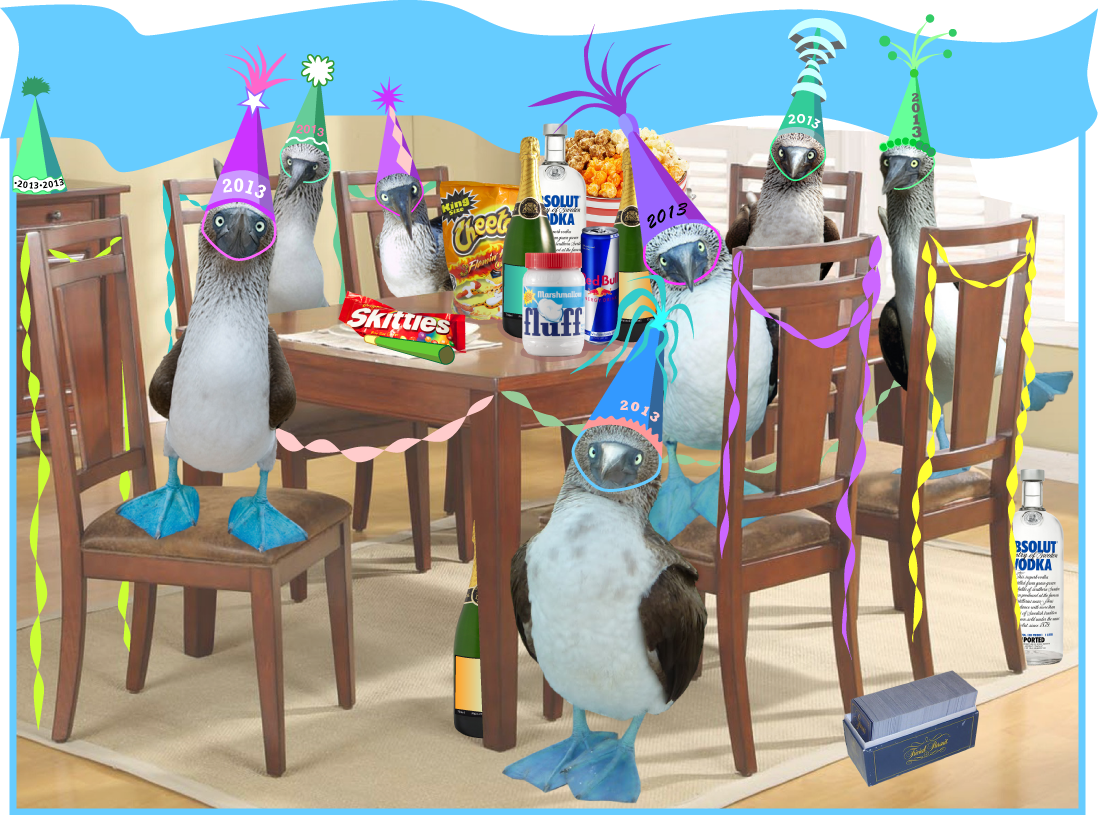
Happy 2013!!

It's amazing what you can see...

...when you look more closely!
Blue-footed boobies wish you a happy happy new year!

Sunday, December 23, 2012

Sunday, October 07, 2012

Wednesday, September 26, 2012

Have you ever been poitrined?

Have you read Little Me (1961), darlings? If you haven't, you have to, and there isn't really anything more to say about that.

It's the biggest joke ever, all the way through--and as such rewards repeated readings extremely well, as there is so much to absorb and catch from slightly different points of view and snortle at and see differently in the text and sometimes very naughty photos that accompany The Intimate Memoirs of That Great Star of Stage, Screen & Television, Belle Poitrine, as told to Patrick Dennis.

Belle Poitrine, née Belle Schlumpfert, of Venezuela, Illinois, is forever mercenary, sluttish, committedly deluded, and vain, whether bleeding dry a series of men ("As Fred had only five thousand dollars, I saw no need to squander it in that squalid hotel"); dumping her two-year-old daughter in boarding school ("I stood silhouetted in the doorway as Baby-dear toddled after Mademoiselle toward the car…'Who's the big blonde?' Baby-dear asked."); or -- my favorite -- offing or otherwise doing nothing to prevent the passing of a series of spouses, such as husband number whatever, studio owner Morris Buchsbaum, who expires after seeing Belle's bank-breaking version of Cleopatra, Nights on the Nile:
"Better I should plotz than see another picture with a gurnisht like you!" A convulsive shudder passed through his entire body. "Ausgeschpielt," he breathed. He sank back onto the pillows, lapsing almost completely into the vivid tongue of his faraway European childhood. But even at this moment my Morris could praise me!
Later Belle is helped down the aisle by her next husband, Letch Feeley (their estate is Belletch), at "dear Morris' high requiem mass."

If nothing else, page through Little Me to see the genuinely amazing poitrine of Jeri Archer (the model who plays Belle in the photos by Cris Alexander), Dennis' virtuoso abuse of scare quotes ("Momma had engaged the services of several very attractive young ladies and held a perpetual 'open house' for America's jolly 'Jack Tars'" [Belle's mother's latest whorehouse, in San Diego]), or the weaving in of imagined interactions with real-life show-biz celebrities ("I approached Ivor Novello to compose an operetta suited to my vocal range. 'CAN PROSTITUTE ART ONLY SO FAR' was his cabled reply.") It is the best. As Charles Busch says in the intro the 2002 re-issue:
This faux memoir of a deluded but determinedly optimistic Grade-Z movie star is a forerunner of the 'mockumentary' that is more and more becoming a staple of American film comedy. This Is Spinal Tap and the films of Christopher Guest…owe much of their deadpan and meticulously accurate tone to this seminal work.

Belle's version of The Scarlet Letter, set at Allstate U.
"Just try to change one comma in some old book about a girl
having a baby in Massachusetts and they're all up in arms!!"

Friday, September 21, 2012

Recession sludge!


I'm lucky: I really love brown rice. Am I lucky? Is that unusual? All I know is I don't get sick of it. Which is good in a recession. This recipe isn't interesting, but I like it. It sustains me, sitting in the deep, heavy Calaphon pan in the fridge, as I scoop out bowls' full during the week. It reheats incredibly well, and can be added to, and sauced, and made more cheesy as the pantry and wallet dictate.

RECESSION SLUDGE

• 1st stage: You need flavoring and fat now--and protein, if you can afford it. So, for instance: very browned meat with aromatics if you're in the mood to chop them (I'm often not), or just spices: heat up some olive oil or butter and crush some dried herbs into it and let them sizzle. This is the stage where I really like to get the extra protein in if I can.  If you have a little minced ham or ground meat, add that. I tend to buy decent-quality protein only on sale and put it in my freezer if I can't use it right away.

In the image below I used four Italian sausages (crumbled out of their casings), browned very crisp and excess fat drained, to which I then added oregano, dry mustard, thyme, Worcestershire sauce, some tomato paste, paprika... I think I threw in some Cotes du Rhone from the fridge door and let it boil off a bit. Basically you want to make a good flavor base of some kind, in enough fat to toast your rice. High temps and a lot of stirring are good here. Make sure there's enough salt and pepper.

• 2nd stage: Throw the rice in and toast it. Plain brown rice is good, but I also like grain combos, if you can get them working: Lundberg rice blends are good, or rice with barley, or rice with quinoa (added later in the cooking process). Stir, stir, stir.

• 3rd stage: Add liquid. Here is the place for stock or broth if you have it, or can afford it. Water's fine, too.

• When it's done: Fluffing the rice and letting it sit is essential once it seems like the rice is really done.

I like to eat it straight with a little extra salt. Or reheated with cheese, if I have some, or a spoon of yoghurt on top. Sometimes instead of putting in the protein in the beginning, I will make a basic veloute sauce and add the protein to that: organic chicken breast, for instance - much easier to deal with in volume - that I roast and make stock from to use for the sauce and and to cook the rice. Make sure the sauce also has lots of flavor: Worcestershire, dry mustard, pepper, thyme, etc. You can make it a cheese sauce with the roux base. Mix it with the cooked rice.

The point is: it is yummy, and because it's whole grain you feel very satisfied, and there aren't a million pans, and it keeps extremely well in the fridge and there are a lot of variations and you know - yum.


Google Voice translates a butt-dial

Very few of these words were actually said: what was actually being "translated" was the sound of walking and then a bit of radio patter. And certainly "Beth" and "Betty" were never said—but Google Voice knows my first name, I guess.
Hey Beth, bye bye bye okay bye, hey. I just bye. Okay bye. Bye, okay hey, bye. Okay bye. And okay bye okay bye bye and bye applicant bye hold on hullabaloo you didn't want to the pretty don't call and hundreds of move. My the guy. And as I would be possible. But if I could call. Okay bye. So, holler, called the are you call. I think it's in it. And what's up. It would be better. Late. Because, below them. Hey, You, hey hello. Please, hey. You is leaving, hopefully The hey and Okay bye. Okay bye. It's okay This. My cancel it, ohh ohh well, call one on east of fun. No, no, and stuff. Yo Yo, hey, it's just the computer okay. We were talking about me would be. We were talking about club okay with you, hey. Hello. Uh huh, okay. Hey, okay. Bush did okay bye week okay. Hey Betty, okay 15 degree. We're gonna be gone.

Wednesday, June 20, 2012

This is what finally inspired me to learn how to make animated .gifs. Her scene is a little tour de force!

Wednesday, June 13, 2012

Because everything I know and understand comes from Gaudy Night, it is inevitable that upon seeing the above, parts of the following crucial passage from that book, about managing one's highest priorities (quoted here before, even--pardon me), floated up in my brain:
You can usually tell . . . by seeing what kind of mistakes you make. I’m quite sure that one never makes fundamental mistakes about the thing one really wants to do. Fundamental mistakes arise out of lack of genuine interest. In my opinion, that is.  
 . . . The big proof is that the thing comes right, without those fundamental errors. One always makes surface errors, of course. But a fundamental error is a sure sign of not caring. I wish one could teach people nowadays that the doctrine of snatching what one thinks one wants is unsound.
I think some people might call them the opposite--call "Amercia" and "Regan" surface errors--but it didn't feel like that to me. In the middle of heavy political rhetoric like that, I couldn't help thinking: What do they really care about?